
The Lifelong Journey of Violin Playing: Why We Must Continuously Tune Our Body Mechanics
Many people think of the violin as an instrument played solely with the hands. However, when working with the numerous advanced students and amateur violinists who visit my studio, the very first thing I emphasize is entirely different: "The violin is an instrument played with the entire body."
If you practice relentlessly but your sound remains harsh, or if you experience neck and back pain after playing for just a short while, it is not a lack of practice. It is a powerful warning sign that you are misunderstanding your body's structural blueprint and overstraining your bones and muscles. In the long journey of learning the violin, I want to share why "continuous postural adjustment" becomes the core of artistry, along with my personal teaching philosophy.
1. The Core of All Sound: Body Core and Weight Delivery
"Stand up straight!" "Force your shoulders down!"
These are the most common phrases heard in practice rooms, but they can often act as poison. Becoming trapped by these instructions forces the superficial muscles to tense up, trapping the body in an incredibly unnatural, rigid state.
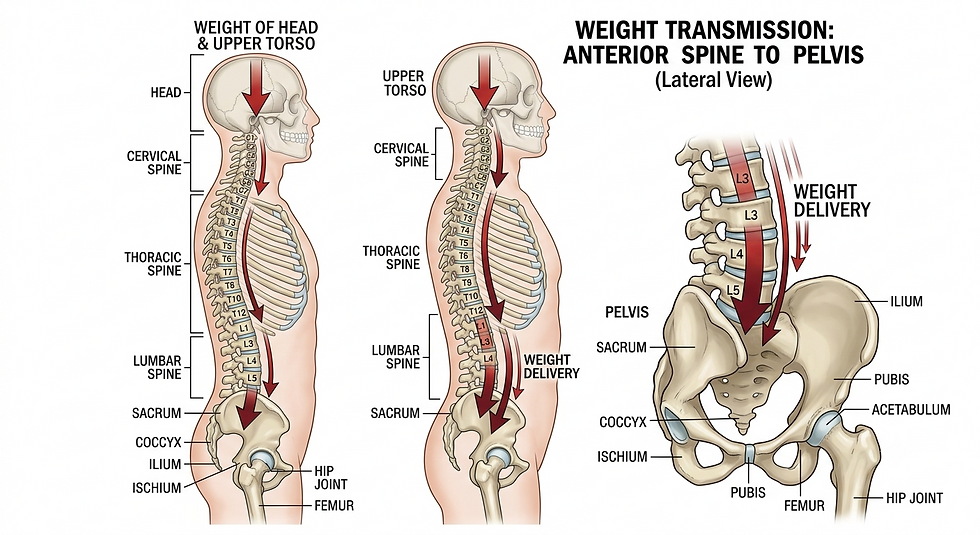
The correct posture I propose is not about bracing with your outer muscles. It is about utilizing your "body core" (the spine and pelvis) to support yourself, whether standing or sitting. When playing standing up, the soft, front segments of the spine must fully accept the weight of the head and upper torso, delivering it smoothly down into the pelvis and the soles of the feet. The same applies when playing seated; the body's weight must be delivered seamlessly down into the chair.
When the core securely takes charge of balance, the superficial muscles of the back and neck no longer need to overwork or compensate. The moment tension dissolves throughout the body, you finally achieve the true stability needed to handle the instrument with absolute freedom.
2. The Body Must Open for the Instrument to Ring: Generating Deep Resonance
Why does engaging the core directly dictate the quality of your sound? The human body contains numerous "natural resonating chambers"—including the throat, nasal passages, and chest cavity.
When bones lose their proper alignment and muscles become rigidly knotted, these internal resonance spaces physically constrict and narrow. While the acoustic properties of the violin itself are crucial, if the performer's own body-as-a-resonator is closed off, the resulting tone will inevitably sound choked, harsh, and flat.
Conversely, when you find balance in your skeletal alignment centered around the core, and the surrounding soft tissues become pliable, these hidden resonating chambers open wide. As the bow hair draws across the string, the instrument and your body begin to vibrate in harmony, releasing a fantastically deep, rich, and mature resonance. Beautiful tone is not manufactured at the fingertips; it is born within the spaciousness of a released body.
3. The Secret Most Violists Don't Know: There Are No Muscles in Your Fingers!
When moving the left fingers busily across the fingerboard from 1st to 4th finger, most players assume they are working their "finger muscles." However, anatomically speaking, there is not a single muscle inside the segments of your fingers. This is a fact very few string players actually know.
The actual muscles that move your fingers are located entirely in the palm of the hand (intrinsic muscles) and the forearm (extrinsic muscles). These muscles connect to long tendons that travel past the base joints of the fingers (where the palm meets the fingers), pulling and releasing them like puppeteer strings to operate the fingertips.
If you don't understand this mechanism, you will instinctively apply excessive, localized pressure directly to the finger joints themselves, creating friction that inevitably stiffens the wrist and invites tendonitis. Furthermore, to keep the base joints of the fingers fluid and free, the elbow, shoulder joints, and back muscles must dynamically support the arm, releasing (de-contracting) in harmony with every micro-movement. The true freedom of your fingers originates not at the tips, but the moment you accurately map and perceive the overarching mechanical network connecting the palm, forearm, and back.

Conclusion: Cultivating "Inclusive Attention"
Are you practicing in a state of narrow "concentration"—staring rigidly at the sheet music or glaring at a single fingertip? This type of hyper-focused tension forces the entire body to constrict and lock up.
The pedagogy I practice aims to cultivate "Inclusive Attention." This is the ability to maintain a relaxed, panoramic awareness of your whole body even while playing—noticing if your neck remains free, if your core is dynamically alive, and how your palm, arm, and back respond in harmony when a finger shifts.
For a violinist, understanding the body is not just about studying cold anatomy. It is a beautiful process of self-exploration: continuously mapping your true structural design, erasing unconscious, harmful habits, and rediscovering your most natural state of balance. Stop practicing through sheer force and physical endurance. The moment you honor the perfect engineering of your body, your music will completely transform.
Comments